


New installations
2025High-speed rail blasting: mechanical pretreatment booth

High performance and grit recovery: the new standard in high-speed rail painting pretreatments
In the High-Speed rail industry, where every component is subjected to extreme stress, mechanical stress, aggressive weathering and continuous temperature changes, the quality of surface pretreatment is the technical foundation on which the durability of the entire coating cycle is built. In this context, properly executed rail blasting is crucial to the performance of the coating.
The quality of blasting directly affects film adherence, corrosion protection and the stability of the result over time. Optimized grit consumption and in-cabin abrasive recovery systems make it possible to maintain a constant level of surface preparation, reducing waste, plant downtime and operational variability-an essential prerequisite in highly industrialized industries such as railways.
For this international customer, a leader in the production of HS trains, Eurotherm is renewing its partnership with the rail industry by designing a custom-made blast booth for the pretreatment of newly manufactured carriages.
Shot blasting for the HS rail industry: abrasive cycle efficiency and quality
The custom blast booth designed and built by Eurotherm for a leading European high-speed rail player is a concrete example of how custom design, process control, and technological innovation can elevate production performance and become a reference for rail blasting.
The new installation ensures a level of substrate preparation consistent with rail industry regulatory standards (ISO 8501 / ISO 8503 / ISO 8504), improving film anchorage, corrosion resistance, and the long-term aesthetic stability of carriages.
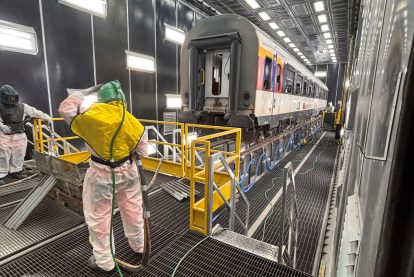
The blast booth is capable of accommodating the AV car in its entirety, for treatment that includes under-crate operation, rooftop and elevated areas; all managed in maximum safety thanks to plant solutions designed to access, ventilate, illuminate and protect the operating environment, while ensuring continuity of service.
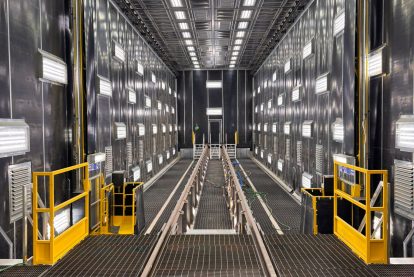
Illuminated aisles below the floor level allow for easy work in under-crate areas. Two hydraulic elevating and sliding platforms on the two long sides of the cab provide safe access to the above-elevated areas and the carriage roof. A raised mezzanine facilitates access to the overhead area of the carriage.
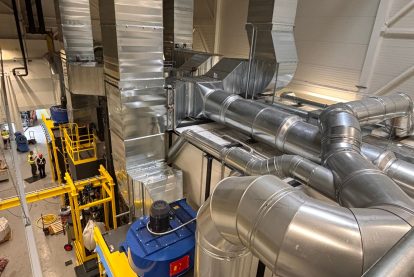
In the booth, the safety of operations is maximized by controlling dust through suction and filtration systems, which ensure a safe environment. Presento filter grids along the walls suck in dust generated by blasting operations. Grit recovery tracks present below the floor grates prevent accumulation and send contaminated grit to the abrasive separation and regeneration system.
The pretreatment plant is distinguished by its efficiency, and ensures optimal surfaces for the application of subsequent protective layers. The custom-built blast booth is 36.5 m long, 7.2 m wide, 7 m high. It is equipped with an automatic grit recovery system via ten scrapers, an auger, and an abrasive recovery and regeneration system with itegrated magnetic sorter, making the plant ideal for rail blasting cycles.
Main regulations for railway blasting and carriage pretreatment
Specific grit standards are required in the rail industry, which define very precise finishing requirements to ensure continuity and repeatability of the process.
International standard SAE J445 specifies methods for testing the strength and quality of the abrasive; SAE J444 is important for defining the grit size of the abrasive.
Adoption of these standards ensures that blasted surfaces have the profile and cleanliness to support durable and resilient paint cycles.
The most relevant standards for rail blasting are generally given in industry technical specifications and refer to the following international standards:
- 01
ISO 8501
Rust grades and steel surface preparation grades.Used to specify the cleanliness of steel surfaces prior to painting.
Defines the levels of surface cleanliness required to ensure adhesion of protective cycles in rail cars. - 02
ISO 8503-1 / ISO 8503-2
Surface roughness characteristics of sandblasted substrates.Provides methods and comparators for evaluating the anchorage profile (roughness) left by abrasion. Essential parameter for the anchorage of anticorrosive primer in railroad painting cycles.
- 03
ISO 8504-2
Preparation methods: abrasive blasting.Operational guidelines on how to perform sandblasting/shotblasting: methods, equipment, process parameters, and operating limits. Details how to achieve the degrees of cleanliness indicated by ISO 8501.
- 04
ISO 8502 (series)
Checking dust, chlorides, condensation before painting.Collection of methods for measuring residual contaminants after cleaning.
Indispensable for checking the absence of contaminants before the application of anti-corrosive primers used in railways.
Get in touch
For high-tech industries, reducing consumption and operating in compliance is a competitive advantage.
Learn about Eurotherm’s rail blasting solutions for strategic production.