


Learning center
2026Pinholes in industrial painting: why they form and how to avoid pinholes
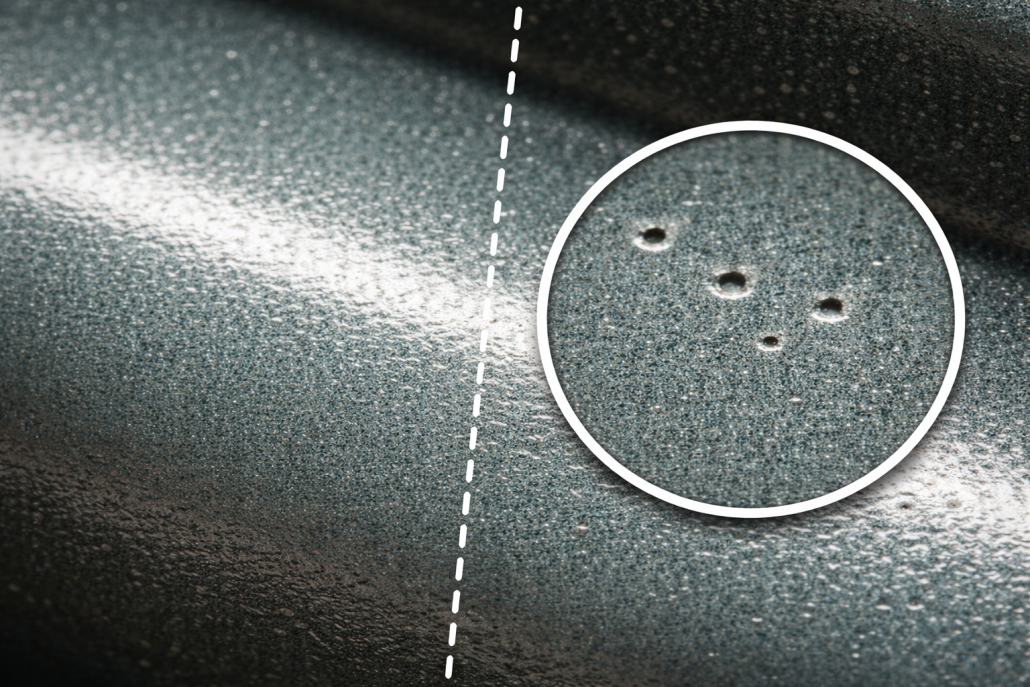
A defect related to the entire painting cycle
Pinholes or pinholes are micro-cavities or point craters that occur on the surface of the painted part immediately after film application or, more frequently, after the drying or curing phase in tunnels and ovens operating at temperatures typically between 140°C and 250°C.
In addition to negatively impacting the aesthetics of the product, these particular surface defects compromise the continuity of the coating and can reduce protective performance and adhesion over time.
In the context of industrial painting, however, pinholes cannot be interpreted as a defect confined only to the stages of paint application and baking. Their formation is, more correctly, the outcome of a sequence of imperfectly controlled variables throughout the entire painting process.
From substrate preparation to drying, from coating application to oven thermal curve management, each stage of coating introduces conditions that can contribute to pinholes and other surface defects, such as orange peel or cratering.
Ineffective pretreatment, the presence of residual moisture, unstable environmental conditions or suboptimal management of process parameters can compromise film uniformity. Addressing the problem of pinholes therefore means taking a systemic approach to industrial coating, in which each process step is analyzed in relation to its own critical variables. Only through integrated management is it possible to structurally prevent the formation of defects and ensure quality, consistency and repeatability of the final result.
Pinholes in liquid coating: causes and critical process issues
In industrial liquid coating, pinhole formation is generally related to the presence of solvents or volatiles trapped in the film.
During the application phase using dispensing guns, the paint is atomized and deposited on the substrate in the form of micro-droplets that, upon baking, result in a continuous film. For this to happen properly, the solvents contained in the product must evaporate in a gradual and controlled manner, typically during the desolvation and flash-off phase, or intermediate evaporation time between the application of the paint and the entry of the part into the drying oven
When evaporation occurs incompletely due to incorrect timing and/or suboptimal environmental conditions, residual solvents become trapped in the lower layers of the film. During oven drying, the abrupt increase in temperature causes rapid evaporation of residual solvents: the phenomenon, known as solvent popping, is the origin of pinholes. In the industrial coating process, in addition to insufficient flash-off times, pinholes can be caused by the following factors.
- 01
Surface contamination during pretreatment and painting.
- 02
Unsuitable viscosity of liquid paint.
- 03
Errors in liquid paint application and/or dispensing gun handling.
- 04
Inadequate ventilation in the spray booth.
Get in touch
Properly analyzing the causes of the pinholes phenomenon in the painting process requires an evaluation of equipment, parameters and operating conditions. The Eurotherm team supports companies in optimizing the painting process, intervening in ovens, thermal curves and degassing management.
Pinholes in powder coating: outgassing and substrate behavior
Unlike liquid paint, powder coating does not contain solvents, and the problem of pinholes is more frequently associated with substrate conditions.
The phenomenon is called substrate outgassing or outgassing and is most likely to occur with microporous surfaces and critical materials (aluminum alloys, die castings, cast iron). Even theoretically compact surfaces, i.e., materials not affected by inherent porosity, can become critical if the surface state is not adequately controlled.
The main sources of risk relate to the environment and process dynamics, below are the main ones.
- Residual surface moisture from washing and rinsing that has not dried completely.
- Organic contaminants such as oils, greases and processing lubricants.
- Chemical residues from pretreatment due to insufficient rinsing or improperly managed baths. During oven curing, especially these substances can evaporate, thermally decompose, and generate gases.
- Incorrect management of temperature parameters of curing ovens.
Process parameters affecting the formation of pinholes
Pinholes are a cross-cutting defect in industrial painting, regardless of the method of application, powder or liquid.
The main cause of microperforations in powder coating is the inability of the substrate to effectively release gases before the coating hardens in baking; in liquid coating, the problem is closely related to the evaporation of solvents used in paint dilution.
Critical issues in pretreatment: contamination, rinsing, and substrate drying
In the area of pretreatment, the main critical issues include:
- Ineffective washes;
- Insufficient rinses;
- Nonuniform chemical conversions;
- contamination of bathrooms;
- incomplete drying.
Application parameters and film control in the coating stage
During painting, it is critical:
- Calibrate the process parameters based on the type of paint, that is, evaluate the chemical category and particle size of the powders, and the viscosity of the liquid film.
- Manage film delivery correctly, i.e., optimize paint application parameters by adjusting spray gun tension and spray distance.
- Control coating thickness and maintain ideal environmental conditions in the spray booth through UTA and efficient filtration and recovery systems.
Firing management: degassing, thermal curve and coating curing
Baking in dedicated ovens and tunnels, must strictly adhere to the curing or drying times stipulated by the specific type of coating.
In the case of powder coating, the phenomenon is closely related to substrate degassing: porous materials, castings, or contaminated surfaces can release gases during heating, generating micro-cavities if the film has already begun cross-linking.
In liquid coating, on the other hand, suboptimal temperature management can compromise the proper evaporation of solvents, leading to bubble formation and subsequent pinholes.
Therefore, it becomes essential to design and control the thermal curve of the oven-considering residence time, temperature uniformity, and ventilation-so as to ensure a gradual release of volatiles before complete film formation.
Get in touch
Pinholes represent the outcome of unstabilized and controlled process conditions throughout the painting cycle. Eurotherm designs industrial painting systems, developing solutions for temperature, ventilation and thermal curve control, with the aim of ensuring quality, uniformity and repeatability of the final result.
How to prevent pinholes in industrial painting
It is now clear that prevention of pinholes does not end with correcting a single variable, but with taking an integrated approach to the painting process.
We therefore point out some good practices that can be adopted to reduce micropunctures and surface defects, and ensure durable and qualitatively suitable coatings.
Stabilize substrate and pretreatment
The first preventive action is to reduce the presence of volatiles at the source.
- Ensure effective washing and rinsing cycles.
- Remove residual oil, grease and contaminants.
- Ensure complete and even drying.
In the case of critical materials or porous surfaces, it is advisable to introduce dedicated pre-heating stages (pre-bake) to promote preventive gas release.
Check the application of paint
The application should be designed not to obstruct degassing.
- Avoid excessive film thicknesses.
- Prefer light multi-handed applications.
- Optimize viscosity and spray parameters.
- Ensure uniformity of deposition.
An inhomogeneous layer can act as a barrier to gas leakage.
Manage evaporation times correctly
In liquid coating, the flash-off phase is crucial.
- Ensure adequate time between application and firing.
- Check temperature and ventilation in the cabin.
- Promote the gradual evaporation of solvents.
Incomplete evaporation increases the risk of solvent popping during drying.
Optimizing the polymerization thermal curve
Oven management is one of the most critical aspects in preventing pinholes, as only controlled thermal uniformity allows for the proper release of gases before complete film formation. The goal is to allow the gases to escape completely before the film finally closes.
Stabilize environmental conditions
Cabin operating conditions directly influence film formation.
- Check temperature and relative humidity.
- Ensure constant and filtered air flows.
An unstable environment introduces variability and increases the risk of defects.
Monitor and maintain the process
Only a stable and controlled system allows quality and repeatability of the end result over time. Periodic inspection and routine maintenance of equipment and spray booths ensure operational continuity and are an effective strategy in preventing pinholes.