


New installations
2025Railway liquid paint plant: energy efficiency and process control

Operational context and objectives of the new line
Eurotherm reinforces its partnership with the European rail industry with the installation of a complete railway liquid paint plant equipped with advanced heat recovery systems to power production space heating.
This new line, designed to support rolling stock maintenance and finishing activities, integrates high-efficiency solutions for thermal control, airflow management, and paint film stabilization. The plant approach adopted makes it possible to combine energy sustainability, coating quality, and operational safety, three central elements in liquid coating processes in railways.
Railway liquid coating: control of process parameters
In industrial railway painting, the quality of the coating depends not only on the application of the paint, but on the ability to tightly control the critical parameters that affect adhesion, appearance and durability of the film.
Temperature, humidity control, vertical flow, and high cabin air exchange-managed via pressurization AHUs-are the key variables of operational processes that, in the high-speed rail sector, must ensure aesthetic uniformity, anticorrosive performance, and resistance to the mechanical and environmental stresses typical of rolling stock and rail operation.
The surfaces of train cars and structural components also have complex geometries and varying dimensions: conditions that amplify the risk of surface defects given by inconsistent drying times and uneven film spreading. Therefore, painting facilities for railroad workshops must be designed to facilitate coating stabilization. Advanced ventilation systems, controlled air exchange booths, stable desolvation, and integrated drying ovens with high-efficiency AHUs make it possible to maintain constant process parameters, optimize energy consumption, and improve finish quality.
Customized design, combined with the use of advanced thermal control and filtration technologies, is an essential prerequisite for ensuring regulatory compliance and consistent performance in liquid railway coating processes
Liquid railway painting plant: painting, desolvation ande drying in controlled cycle
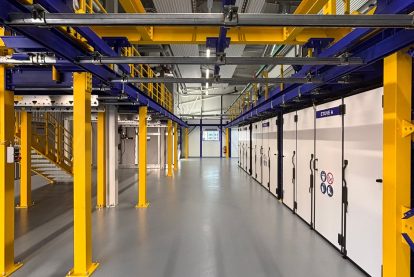
The liquid railway coating plant designed and installed by Eurotherm at the customer site in France ensures a controlled process, more sustainable production and certified product finishes.
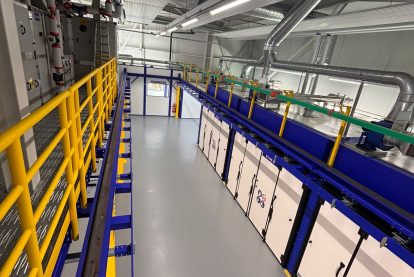
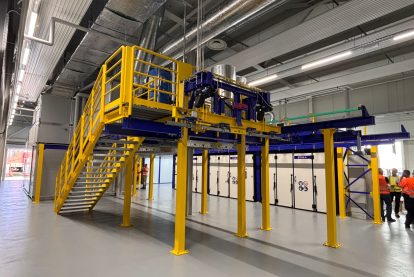
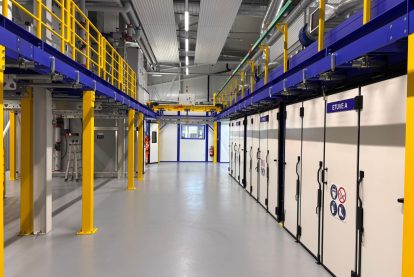
The line consists of:
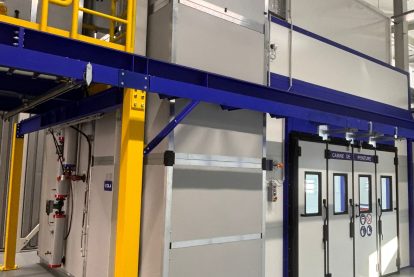
- Pressurized manual liquid paint booth with AHU for temperature and humidity control.
- Desolvation cabin.
- No.3 drying kilns.
- Paint workshop.
- Overhead conveyor with lift station for loading-unloading and manual part conveyor.
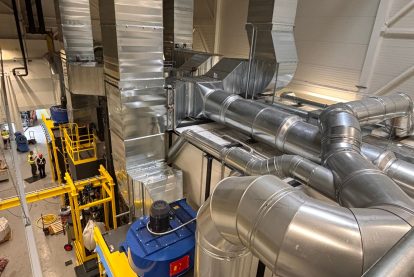
- Production plant heating compensation AHU.
Automation and control of railway painting cycles
The hallmark of the plant is the level of flexibility of the coating cycle. Customized management of the cycles-from part loading to handling along the different painting, desolvation and baking stations-guarantees consistency, uniformity and repeatability of the process, and improves the safety of operations by limiting the intervention of line workers.
Control of liquid paint application-uniform vertical airflow, speed and distance of application-and accurate management of surface heat treatment-flash-off and baking times and temperatures, on the other hand-contributes to film uniformity, i.e., integral, long-lived and defect-free surface coverage.
Pressurized cabin and thermo-hygrometric control
The pressurized spray booth reproduces the optimum conditions for paint application thanks to the aeraulic balance of the system managed by an AHU – Air Handling Unit that regulates the inlet and outlet flows, to allow operation at controlled temperature and humidity. Filtration systems in the inlet plenum and on the floor, ensure constant air flusos over the entire surface of the booth together with the healthiness of the working environment by capturing and filtering overspray in the booth.
Paint management and safe storage
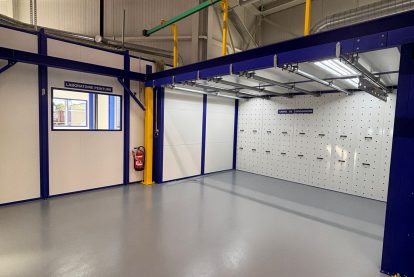
A paint lab or storage container placed at the service of the spray booth allows the organization of paints and solvents and dispensing tools, within technical rooms designed to meet any dimensional and customization requirements, with the utmost attention to safety.
Between paint application and final drying in the 3 ovens designed to perform progressive firings at variable temperature ranges, the workpieces pass through the desolvation chamber, where they undergo an intermediate flash-off aimed at evaporating solvents and stabilizing the coating.
Desolvation: a critical step for railway components
Desolvation is a critical step in rail liquid coating, especially when using thick anti-corrosive primers, as the massive use of anti-corrosive primers and the thick finishes needed to withstand the stresses involve high amounts of solvent that must evaporate properly so as not to create retention and defects in the film.
Drying kilns and energy recovery
After desolvation, the pieces are transferred by manual overhead conveyor to the three drying kilns equipped with heat recovery systems in extraction, heat that is exchanged with the incoming cold air and reintroduced into the firing chambers.
Both AHUs-the one serving the spray booth and the one for compensating heating systems-are collectively capable of achieving energy efficiency close to 50 percent.
Compliance in rail liquid coating plants: VOC, ATEX regulations and design requirements
In the context of liquid railway paint plants, the European Directive 1999/13/EC (VOC Directive, now incorporated into Legislative Decree 152/2006, is a reference standard for the management of solvents in liquid railway paint processes, for tolerable levels of VOCs, volatile organic compounds from solvents used for liquid paint. Compliance with the standard is structured not as a final verification step, but as an integral part of the production processes, particularly in the pressurized booth equipped with an AHU.
Compliance of a coating plant with the VOC Directive 1999/13/EC is achieved through a set of design and management measures, and high-efficiency technologies, integrated into a single ecosystem, configured for the purpose of reducing atmospheric emissions and ensuring regulatory compliance of the product.
New generation plants offer solutions and strategies to limit environmental impact and safely manage all process steps, including ATEX aspects, which are particularly relevant in solvent application areas. Among the main pillars of compliant operation are:
- Reducing VOCs at the source by selecting low-solvent paints or preferring water-based paints.
- Optimization deli paint application methods to reduce consumption and overspray formation.
- Control and capture of cabin emissions through filter systems.
- Controlled thermal management to prevent uncontrolled evaporation of solvents.
Get in touch
Eurotherm designs custom paint systems that meet industry technical and regulatory standards.
Our engineers are available to assess your needs.