


Learning center
2025Powder coating adhesion: what to do when paint does not adhere
Adhesion problems in powder coating: how to recognize them
Failure of powder coating to adhere is caused by errors in pretreatment, electrostatic charge, or baking of the coating. To ensure uniform adhesion, it is essential to check the grounding of the parts, the electrostatic charge, and the baking temperature of the coating.
Powder coating is one of the most popular processes in industry for achieving strong, durable finishes with a strong aesthetic impact. However, even the most experienced professionals face a frequent defect: failure of the paint to adhere to the substrate.
This paint defect can have several manifestations:
- the coating does not adhere to the substrate in any way;
- the paint adheres to the piece only partially;
- the coating does not reach some parts of the surface;
- paint adheres, but does not last over time.
To understand the extent of the problem, it is useful to measure the degree of adhesion. The degree of adhesion can be measured by a “cross-cut” or “cross-cut” test.(ISO 2409:2020 – Cross-cut test).
It is a simple but standardized method for objectively identifying any defects before the part moves on to the next stage of processing. The test result is graded according to the scale provided by ISO 2409, providing a clear and verifiable figure that is useful both for internal quality control and for comparing with suppliers or those who handle pretreatment and painting.
So what is the cause of powder coating adhesion problems?
It is not easy to identify just one, as the powder coating process is subject to both painter error and surface characteristics of the part, two factors that can overlap and complicate analysis on the origin of the defect.
In this article we are going to address the main issues of powder coating adhesion and the possible solutions to be implemented to achieve a long-lasting result that can withstand external agents. In particular, we will focus on how to solve the lack of adhesion of powder coating by:
- The optimization of pretreatment to remove impurities;
- The correct calibration of plant parameters;
- The management of complex geometries.
Pretreatment and cleaning: how to improve powder coating adhesion
A well-executed pretreatment allows for uniform application and extends the life of the coating. If this step is not done properly, the coating will adhere to the dirt and residue on the part and not to the surface.
Before painting, debris left on the part from previous processing and any contaminants must be removed. To remove these,
Next, each part must be cleaned of dirt and grease residues, using detergents and solutions specific to the substrate and type of contaminant. In the industrial setting,
Pretreatment must be calibrated according to the intended use of the item and the required performance. Powder coating also finds application in the ACE (Agricultural, Construction and Earthmoving equipment) sector, which includes agricultural, construction and earthmoving equipment, where mechanical strength, corrosion protection and durability of the coating are essential.
Calibrate the system to improve powder coating adhesion and avoid paint defects
Powder coating must adhere to precise parameters for each production run. To best control these factors, one relies on PLC technology, which returns all production parameters in real time, and partnership with one’s supplier.
The electrostatic charge of the workpiece and the firing temperature are the two key elements to be controlled to ensure proper adhesion of the coating.
How to properly arrange parts to ensure electrostatic charge and dust adhesion
During paint application, workpieces must be electrostatically charged in order for the powder to adhere to the surface. If instead of settling on the workpiece, the paint settles on the operator, the electrostatic charge may not have been transmitted to the workpiece to be coated.
To solve this problem, it is necessary to check that the flight bars that support the piece are clean. The paint residue acts as an insulator and does not allow the charge to be transported, thus preventing the dust from adhering to the surface. These small steps are part of plant maintenance. If not done carefully, the entire production will suffer.
Powder coating booths: vertical flow with filter roof vs. horizontal flow
The configuration of the spray booth has a major influence on the quality and uniformity of powder application. Vertical flow booths with filter roofs ensure a more stable air flow, reducing the risk of contamination.
Horizontal flow cabins, on the other hand, offer greater accessibility.
In both cases, the design must ensure a balance between vacuum system efficiency, ease of cleaning, and continuity of the production process.
Calibrate the paint oven: thermal control for uniform and durable adhesion
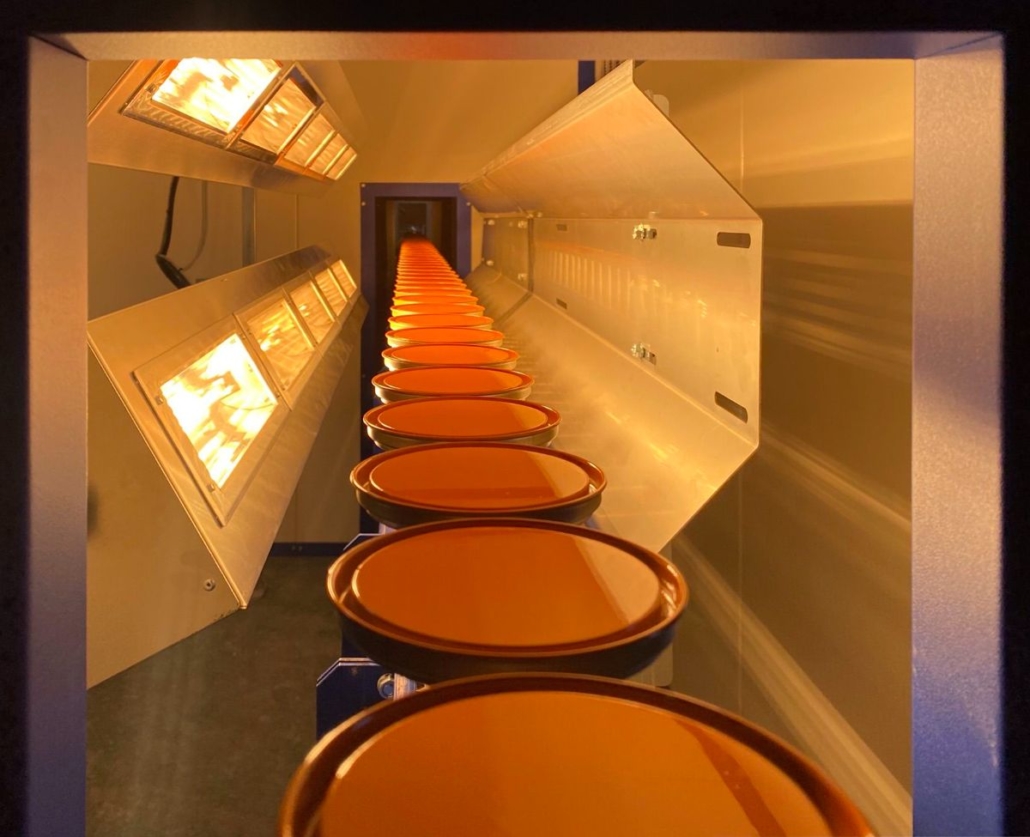
Knowing your oven allows you to prevent firing errors that are difficult to reverse. Depending on the material to be treated and the paint to be cured, the firing should follow the instructions on the manufacturer’s sheet. To do this, one must know the heating time of the machine and the piece inside it. Even if you have calculated the correct times, the result may not be as desired.
The cause? A problem often lurks in the oven that could silently ruin your coating: cold. Temperature changes given by “dead spots” where cold air builds up in the oven lead to uneven and incomplete curing. The result is a coating prone to poor adhesion and susceptible to shocks and chemicals.
This is why it is essential to rely on qualified Eurotherm technicians who can measure temperature gradients with professional instruments and rule out any cold spots or so-called “dead spots,” which can compromise coating adhesion.
Get in touch
Rely on Eurotherm’s experience. Our skilled technicians design, install and test industrial powder coating ovens.
Contact us for a customized technical evaluation of your facility-we will analyze temperatures, airflows, and critical points to ensure perfect and long-lasting coating adhesion.
Dealing with complex geometries: how to line corners and recesses
Powder coating adhesion defects in corners and recesses are among the most frequent in industrial production with complex geometries. The conformation of the workpiece influences the distribution of the electrostatic field and makes it difficult for uniform powder deposition.
This phenomenon, known as the Faraday cage effect, leads to uncovered or poorly coated areas, with negative consequences on aesthetics and strength. On our website you can learn more about how Eurotherm designs powder coating systems to minimize these defects in productions with corners, recesses and irregular surfaces.
Selection and maintenance of spray nozzles: precision for a uniform finish
To apply powder coating to specific areas, it is necessary to check the nozzles that will modulate the delivery from the gun. Flat spray nozzles are suitable for covering large areas, while round nozzles are suitable for recesses and small indentations. Nozzles also require maintenance. These attachments can retain residual dust from previous applications, so it is important to clean them after each job. Accumulated dust not only contaminates the coating but also prevents even and consistent paint delivery.
High-penetration coatings and epoxy resins: solutions for complex surfaces
Due to constant innovation in industrial coating, high-penetration thin-film coatings have been developed that counteract the “cage” effect and reach surface indentations. An optimal solution, but one that may not be suitable for your production.
If compatible with your needs, another option may be epoxy: a highly elastic coating with good adhesion both on linear surfaces and on corners and edges.
Implementing customized solutions
To improve powder coating adhesion in industrial processes, Eurotherm develops customized solutions that integrate vertical flow coating booths with filter roofs, multistage washing tunnels, and ovens calibrated to eliminate cold zones and ensure uniform cure. The goal is to ensure process continuity, waste reduction and consistent coating quality, with custom-designed facilities where powder coating is the technology of choice for strength, durability and mechanical performance.