


Learning center
2026Paint drying after pretreatment: how to avoid surface contamination and prevent paint defects
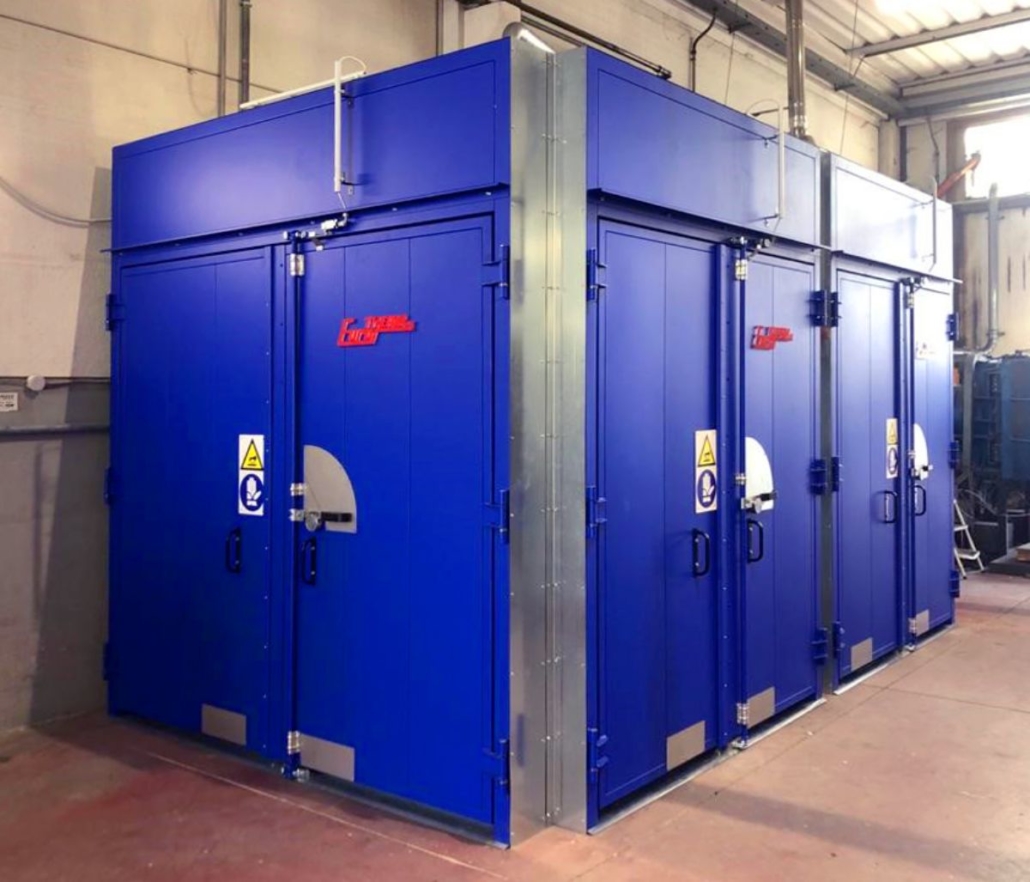
Drying, drying and curing: a fundamental distinction in the painting process
In the context of industrial painting, the term drying refers to the physical removal of water or residual surface moisture after wet pretreatments, such as washes, technical rinses and chemical conversion treatments.
This phase represents a critical transition between surface preparation and coating application and is crucial to the quality of the final result: properly executed drying makes it possible to avert the risk of surface contamination, preventing the most common coating defects and ensuring stable and repeatable conditions for the next phase of coating application. In the technical language of industrial painting, the terms drying and paint drying are sometimes misused.
Instead, it is crucial to distinguish its meaning within the process:
- Drying (dry-off): removal of residual water after wet pretreatments, prior to paint application.
- Paint drying: the stage following the application of liquid coatings, during which the evaporation of solvents or water and the formation of the film takes place.
- Polymerization: chemical cross-linking reaction typical of powder coatings and liquid heat-curing systems.
Drying before painting: solutions and operational contexts
After the pretreatment stages that include washing and degreasing, technical rinses, and any chemical conversion treatments, the parts must go through a drying stage designed to stabilize the surface conditions obtained, that is, to make the pieces to which the paint will be applied chemically and thermally stable.
In various areas of industrial production, drying performs several functions:
- Controlled water removal: prevents stagnation in complex geometries and averts flash oxidation phenomena in steels.
- Controlled moisture removal: prevents damage to the microstructure, as wet surfaces are mechanically more fragile.
- Thermal conditioning of the artifact: promotes the application of liquid paint, or the deposition and curing of powder paint.
- Conversion layer stabilization: to create uniform surface conditions in the case of chemical treatments.
Drying that is not consistent with the types of pretreatment and painting can irreparably alter the condition of the part to be painted and adversely affect adhesion, film uniformity and durability of the coating. The choice of the most suitable drying mode is also closely related to the material being treated, as especially steels and some advanced materials require specific and controlled cycles. This makes clear the crucial role of drying-a seemingly neutral process step that, on the contrary, embodies the design response to specific critical issues related to part temperature, residual moisture, part geometry and cycle repeatability.
Humidity and dew point control: an often underestimated parameter
In addition to temperature and time, a critical parameter in the drying phase is the dew point.
If the surface temperature of the artifact approaches the dew point of air, moisture recondensation may occur, even after apparently proper drying. This phenomenon is one of the main causes of:
- Flash oxidation on steels;
- Loss of film adhesion;
- blistering and surface defects after paint drying.
A proper drying design must therefore ensure that the temperature of the part remains stably above the dew point, introducing adequate safety margins.
Industrial drying technologies: the main variables in control
Industrial drying technologies address the need for precise control of key process variables: temperature, humidity, and exposure time.
Drying ovens and tunnels operate according to principles of heat and mass transfer, adapting to the characteristics of the treated materials and the geometries of the manufactured goods. Among the main solutions adopted in industrial coating lines are:
- Forced hot air drying tunnels: ideal for complex geometries and materials with high thermal inertia, they work with high temperatures and timings compatible with high-throughput lines.
- Convection hot air drying tunnels: useful in case of parts with simple geometries, in contexts where it is not necessary to control environmental conditions.
- Drying tunnels with dehumidified air: typical for settings with high ambient humidity, where there is a risk of condensation or for surfaces susceptible to oxidation.
- Drying tunnel with filtered air: adopted in industries with high quality requirements, such as premium automotive, precision components, cosmetics & pharma.
Drying tunnels are generally placed between the pretreatment plants and the coating lines and, like the other units, must be integrated into the production context with a design approach that considers the whole plant. They must also ensure, just like the other in-line elements, consistency in quality and repeatability of the result. In more advanced plants, they are also affected by design strategies for excess heat recovery andenergy efficiency.
The selection of the most suitable drying technology cannot be separated from the combined analysis of:
- material of the artifact;
- geometry of the part;
- environmental conditions;
- Coating quality requirements;
- Repeatability required by the production process;
Paint defects related to improper drying
Suboptimal management of the drying phase can generate defects that manifest themselves both immediately and after paint drying or curing:
- Flash rust on steels: caused by residual moisture or surface recondensation.
- Craters and fish eyes: often related to contamination present in the drying air.
- Blistering and delamination: due to trapped moisture in the substrate.
- Poor film adhesion: consequence of improperly stabilized surfaces.
Thus, proper drying design represents a true preventive action on paint defects, rather than just an intermediate process step.
Heat recovery systems in drying processes
In modern industrial drying systems, the management of the most thermally energy-intensive technologies is increasingly complemented by heat recovery solutions, which allow the energy contained in exhausted air streams to be reused.
This approach not only responds to energy-efficiency logic, but also contributes directly to process stability, ensuring consistent and repeatable conditions throughout the production cycle. These systems, designed to fit the plant’s energy supply logic, recover and reuse for other purposes, heat that would otherwise be lost. Among the most widely used in industrial settings:
- Air-to-air recovery via heat exchangers: hot air, drawn in via exhaust fan, is fed back into the tunnel.
- Recovery on adjacent production streams: excess heat is used to power other in-line processes.
Heat recovery from spent air streams represents a design choice geared toward reducing energy needs and dependence on fossil fuels. This integration facilitates the adoption of more efficient and sustainable production models, particularly in contexts subject to stringent environmental regulations.
Get in touch
Contact us to find out how Eurotherm’s industrial painting solutions can improve the energy efficiency of the entire production process and reduce operational and environmental costs.