


New installations
2025Multistage automatic washing tunnel for large metal structures: the Eurotherm mega plant in France

Multistage washing plants: how a system is designed for large parts
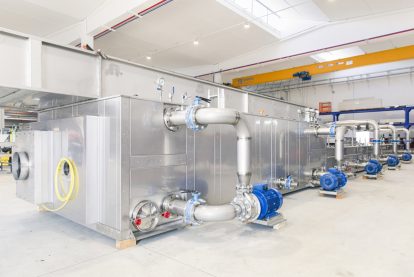
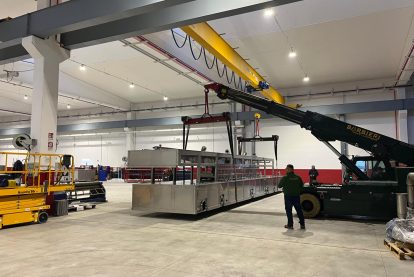
Eurotherm has built and installed a two-chamber washing tunnel for the functional pretreatment of large metal products at the new headquarters of a prestigious French group that is a leader in the processing of steel and other ferrous materials.
The design approach adopted for this installation allows a close look at the configuration of the multistage automatic washing tunnel, the process logics, the integrated anti-corrosion strategies and the UNI EN ISO normative references that guide the definition of the pretreatment cycles. The project is part of Eurotherm’s range of solutions dedicated to automatic washing tunnels used in industrial powder coating lines.
Powder coating of metals: solutions for chemical pretreatment of surfaces
In highly industrialized sectors-energy, transportation, aerospace-powder coating is an integral part of the production of performance components that meet the requirements for operational functionality and regulatory compliance related to specific contexts of use.
In these areas, the aesthetic value of the product is intertwined with the durability, strength, resilience and performance requirements of certain product categories, which are exposed to corrosion, mechanical stress and wear. In addition, the unavoidable use of special materials such as ferrous alloys requires special attention in defining the steps and processing times of pre-coating operations – planning that is essential to meet standards and ensure maximum product reliability.
Special attention is paid in this regard to pretreatments aimed at surface preparation, which must be parameterized according to the composition of the substrate. Degreasing, pickling, phosphating: the choice of the most suitable treatments depends on various factors related to the degree of automation of the process, the performance objectives and the intrinsic characteristics of the metal artifacts to be treated-variables that go into conditioning the exposure time and temperature of the baths, as well as the choice of pretreatment products.
Multi-stage functional pretreatment for removal of surface contaminants
The pretreatment system designed by Eurotherm for the French industrial group completes an automatic powder coating line dedicated to processing large iron components for the construction and transportation sectors-maritime, rail, aerospace and ACE.
Thanks to its experience in designing complex plants for heavy-duty applications, Eurotherm has developed a tailored solution capable of ensuring production continuity and compliance with the required technical standards.
Specifically, the multistage automatic washing tunnel installed in this new production facility can accommodate parts up to 2.5 meters high, with a length of 10 meters and a maximum weight of 3,000 kg. These features configure it as one of the largest facilities in France capable of processing large metal parts: building components, architectural structures, window and door frames, lighting poles, solar panel supports, and street furniture elements.
The power&free overhead conveyor, designed to automate handling operations, enables continuous, step-by-step advancement of parts along the entire processing line.
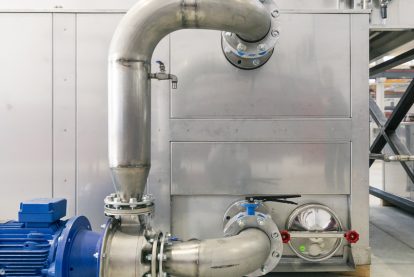
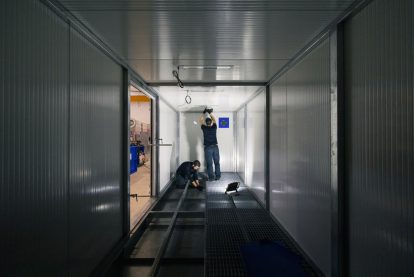
The surface washing cycle takes place in several stages inside the multistage automatic washing tunnel consisting of two chambers separated by automatic doors; in the first chamber, hot degreasing is carried out, while in the second automatic washing chamber, two rinses with mains water followed by a rinse with osmo water are performed.
Washing operations aim to progressively remove lubricating oils, greases and chemical residues that could compromise theadhesion of the surface coating. At the conclusion of the cycle, passivation maximizes the effectiveness of decontamination, which generates a nanoscale film of reinforcement on the surface. Each stage of the process has a dedicated tank for the recovery of liquids, avoiding cross-contamination and allowing them to be reused for efficiency and sustainability.
Get in touch
Eurotherm engineers are available to assess production requirements, critical operational issues and specific regulations related to pretreatment and automatic washing processes.
Request a technical discussion to identify the most suitable configuration of the washing tunnel and process steps.
Spray tunnels: maximum efficiency and minimized contamination
In Eurotherm’s automatic washing tunnels, design is geared toward ensuring maximum energy efficiency, reduced contamination and process sustainability.
Each plant integrates technologies developed according to the 3R model of industrial ecology – reduce, reuse, recycle – that guide the entire surface treatment cycle, from liquid dispensing to recovery management.
Particular attention is paid to limiting chemical dispersion, controlling flow rates and recirculating wash liquids, elements that contribute directly to reducing consumption and operating costs.
Anticorrosion in multistage automatic washing systems: EN ISO guidelines
In the context of a plant designed to treat large metal artifacts, the definition of the correct pretreatment cycle cannot disregard the anti-corrosion requirements of different application areas.
It is at this stage that EN ISO standards come into play, guiding the selection of the most suitable solutions and their integration within the washing tunnel.
As can be guessed, in the area of pretreatment, therefore, there is no one process that is absolutely preferable. Therefore, in order to identify the type of mechanical and chemical pretreatment that best serves one’s purposes, apreventive analysis tailored to production needs is essential to understand how to adequately prepare surfaces for subsequent painting.
In order to identify the type of mechanical and chemical pretreatment that best serves one’s purposes, it is essential to conduct a customized preventive analysis of production needs to understand how to adequately prepare surfaces for subsequent painting.
In the area of ferrous metals (steel, treated steel) and nonferrous metals (alloys, aluminum, copper, zinc, stainless steel) for example, anti-corrosion treatments are critical to product quality and regulatory compliance.
UNI EN ISO 12944 standards are the international reference standards for corrosion protection of steel structures, mainly through pretreatments and painting. The set provides guidelines for:
- The classification of corrosive environments (UNI EN ISO 12944-2);
- The design of structures (UNI EN ISO 12944-3);
- The preparation of surfaces (UNI EN ISO 12944-4);
- The protective coating systems (UNI EN ISO 12944-5);
- Laboratory tests to evaluate the effectiveness of protection (UNI EN ISO 12944-6);
- Performance and supervision of painting work (UNI EN ISO 12944-7);
- specifications for new and maintenance work (UNI EN ISO 12944-8);
- offshore environments (UNI EN ISO 12944-9).
EN ISO 14713, on the other hand, is used to verify the protection against corrosion of steel structures and artifacts by zinc coatings, particularly hot-dip galvanizing.
The procedure that designers of industrial painting equipment are therefore asked to follow in order to operate in accordance with industry regulations includes the following steps:
- Establish the “rated life” required of the structure, thus identify the durability of corrosion protection systems (UNI EN ISO 12944- 1:2001 paint) (UNI EN ISO 14713:2010 galvanizing).
- Identify and classify the corrosivity of the environment in the area where the structure will be located (UNI EN ISO 12944-2:2001 paints) (UNI EN ISO 14713:2010 galvanizing). Identify any special corrosion conditions.
- Design the structure to ensure adequate accessibility for corrosion protection work (UNI EN ISO 12944-3:2001 in case of protection by painting) (UNI EN ISO 14713:2010 in case of galvanizing).
- Identify the treatment that provides the required durability for the environment in question (UNI EN ISO 14713:2010 galvanizing) (UNI EN ISO 12944-5:2008, UNI EN 13438:2006 for paints), based on the laboratory tests required by ISO 12944-6:2001.
- Establish a maintenance program extended throughout the in-service life of the structure (UNI EN ISO 12944-8:2002 for paints) (UNI EN ISO 14713:2010 for galvanizing).
- Ensure that damage to the environment and all risks to the health and safety of operators and users are minimized (UNI EN ISO 12944-1:2001 and UNI EN ISO 12944-8:2002).
Corrosion classes and pretreatment requirements for multistage washing plants
In the context of a multistage washing plant designed to ensure consistent quality on large metal artifacts, corrosive risk assessment is an essential step.
To correctly define the pretreatment cycles and size the tunnel to the actual operating conditions, it is essential to analyze the corrosivity class of the environment in which the final product will be used.
Any preventive risk analysis, starts from the knowledge that the combined effect of moisture and oxygen in the atmosphere is the first, inevitable cause of corrosion.
Corrosion phenomena increase dramatically in the presence of pollutants such as sulfur dioxide SO2 or hydrogen sulfide H2S in the atmosphere, or again in the presence of metal surface contaminants such as chlorides. Thus, atmospheric corrosion is particularly intense in industrial and urban areas, and near the sea, and can be intensified by the presence of contaminants on the metal surface.
It is therefore essential to establish the corrosivity class of the context of product use. The table derived from ISO 9223 – Corrosion of Metals and their Alloys, and UNI EN ISO 14713 – Zinc Coatings, Guidelines and Recommendations, gives 6 corrosivity classes and qualitative examples of typical environments:
- C1 – very low / habitable interior;
- C2 – low / natural areas, unheated interiors;
- C3 – medium/low-polluted urban environments and industrial areas;
- C4 – high/industrial areas, coastal areas, chemical plants;
- C5-I – very high / presence of aggressive industrial pollutants;
- C5-M – very high/marine areas, offshore.
Get in touch
With our expertise in designing plants for complex applications, Eurotherm supports companies in choosing the best pretreatment and washing solutions.
Contact our engineers for dedicated advice and optimize your paint preparation process.